
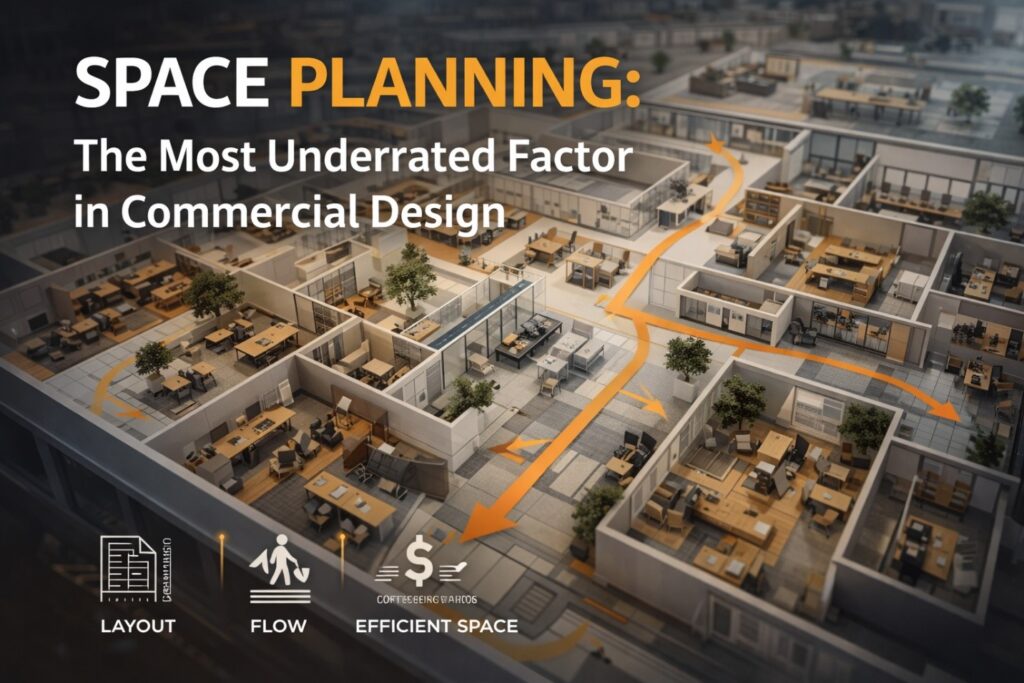
Why Great Design Starts with Layout — Not Finishes
When people think about design, they often picture finishes — materials, colors, lighting, furniture. But in reality, none of that matters if the space itself doesn’t function properly. At TRNKY, we believe the success of any commercial project begins with one critical step: Space planning. Before a single material is selected or a wall is built, the layout must work — efficiently, intelligently, and with purpose.
What Is Space Planning?
Space planning is the strategic organization of a space to ensure efficient workflow, proper circulation, functional zoning, maximum usability, and future flexibility. It’s not just about fitting furniture — it’s about designing how people move, work, and interact within a space.
Why Space Planning Matters More Than You Think
1. It Directly Impacts Productivity
In an office environment, poor layout leads to bottlenecks, noise conflicts, inefficient movement, and wasted square footage. A well-planned space improves how teams operate daily — without anyone even realizing it.
2. It Prevents Costly Changes Later
One of the biggest mistakes in commercial projects is: “We’ll figure it out as we go.” That approach leads to reframing walls, electrical rework, HVAC adjustments, and change orders, all of which cost time and money. A strong space plan eliminates these issues before construction even begins.
3. It Maximizes Every Square Foot
In markets like NYC, space is expensive. A good layout ensures no dead zones, proper room proportions, smart storage integration, and multi-functional areas. You’re not just designing a space — you’re optimizing an investment.
Key Elements of Effective Space Planning
At TRNKY, every layout is built around a few core principles:
Flow & Circulation
Clear pathways that feel natural — not forced or cramped.
Zoning
Separating spaces based on function: public vs private, quiet vs collaborative, operational vs client-facing.
Adjacency Planning
Placing the right spaces next to each other: conference rooms near offices, reception near entry, support areas near work zones.
Scalability
Designing with growth in mind — not just today’s needs.
Design Without Planning = Problems
A space can look beautiful and still fail. We’ve seen projects where offices are too tight, meeting rooms are oversized and underused, electrical doesn’t align with furniture, and teams outgrow the layout within months. All of this comes back to one thing: Poor planning at the beginning.
How TRNKY Approaches Space Planning
Unlike traditional approaches where design is fragmented, we integrate space planning into the very first phase of every project. Our process includes:
- Understanding your operations — how your team works, your daily flow, your future growth.
- Creating multiple layout options — not just one idea, but strategic alternatives.
- Aligning design with construction early — so what we design is actually buildable and efficient.
- Coordinating with all trades from day one — electrical, HVAC, lighting, and furniture. This is where our design-build model becomes powerful — everything is connected from the start.
Final Thought
Finishes can always be upgraded later. Layouts cannot. That’s why space planning isn’t just part of design — it is the foundation of design.
Looking to Design Your Next Space the Right Way?
At TRNKY, we don’t just design spaces that look good — we design spaces that work. From planning to execution, we handle everything under one roof. Design. Build. Procure. Deliver.