
The Most Expensive Mistakes in Construction Happen Before Construction Begins
When people think about construction projects, they often focus on the visible elements—beautiful finishes, impressive architecture, and the final completed space.
What many don’t realize is that the success or failure of a project is usually determined long before the first wall is framed or the first piece of material is delivered.
The foundation of a successful project isn’t concrete.
It’s information.
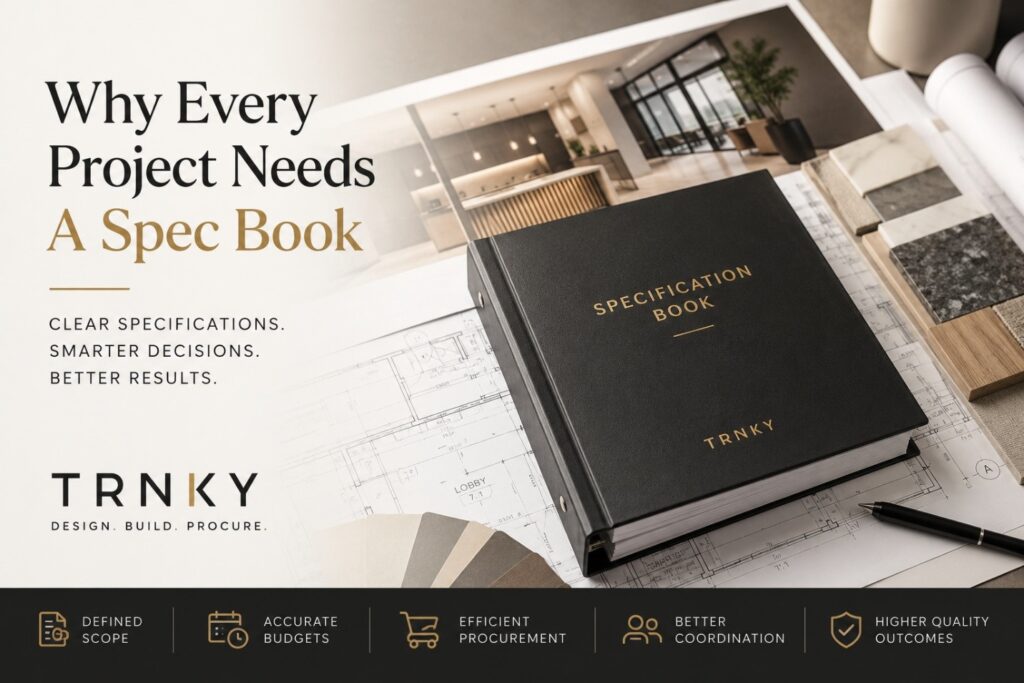
More specifically, it’s a properly developed specification book.
At TRNKY, we’ve seen firsthand how projects with comprehensive specifications consistently outperform projects that rely on assumptions, verbal instructions, or incomplete documentation.
Whether it’s a commercial office, hospitality space, healthcare facility, retail environment, or residential development, every successful project begins with clear and detailed specifications.
What Is a Spec Book?
A specification book is the project’s instruction manual.
It defines exactly what is being built, how it will be built, what materials will be used, who is responsible for each component, and the standards that must be achieved throughout construction.
A properly prepared specification book typically includes:
- Material selections
- Product manufacturers and model numbers
- Finish schedules
- Equipment specifications
- Installation requirements
- Performance criteria
- Quality standards
- Procurement requirements
- Warranty requirements
- Construction coordination notes
Simply put, it removes uncertainty.
The Cost of Assumptions
One of the biggest causes of project delays and budget overruns is assumption-based decision making.
Without clear specifications:
- Contractors make interpretations.
- Vendors quote different products.
- Procurement teams order incorrect materials.
- Installers encounter conflicts in the field.
- Clients receive inconsistent pricing.
- Change orders increase.
Every assumption creates risk.
And risk always has a cost.
A missing specification today can become a costly change order tomorrow.
Better Budget Accuracy
One of the greatest benefits of a spec book is accurate pricing.
When contractors bid from incomplete drawings or vague scopes, every bidder fills in the gaps differently.
This often creates large pricing discrepancies and makes it difficult for owners to compare proposals fairly.
With a detailed specification book:
- Everyone prices the same scope.
- Material allowances are clearly defined.
- Procurement requirements are identified early.
- Budget forecasting becomes more reliable.
The result is fewer surprises and greater financial control.
Procurement Starts Earlier
Modern construction projects are heavily impacted by lead times.
Lighting fixtures, millwork, doors, hardware, furniture, specialty finishes, HVAC equipment, and custom materials often require weeks—or even months—to manufacture and deliver.
Without a spec book, procurement cannot begin with confidence.
Without procurement, schedules begin slipping.
A complete specification package allows teams to:
- Identify long-lead items.
- Sequence purchasing correctly.
- Lock pricing earlier.
- Coordinate deliveries efficiently.
- Avoid project delays caused by material shortages.
Procurement should never start with guesswork.
Improved Coordination Between Trades
Every project involves multiple disciplines working together.
Architects.
Engineers.
General contractors.
Subcontractors.
Suppliers.
Procurement teams.
Owners.
When specifications are clearly documented, everyone works from the same source of truth.
This improves coordination between:
- Framing and electrical systems.
- HVAC and ceiling layouts.
- Millwork and lighting.
- Plumbing fixtures and finishes.
- Furniture and architectural design.
The result is fewer conflicts, fewer RFIs, and a smoother construction process.
Higher Quality Outcomes
Quality does not happen by accident.
Quality happens when expectations are clearly defined.
A specification book establishes standards before construction begins.
Instead of asking:
“What should this look like?”
The team already knows.
This creates consistency throughout the project and ensures that the finished product aligns with the original vision.
The Spec Book Becomes the Project Roadmap
Many project teams view drawings as the primary project document.
In reality, drawings show where things go.
Specifications explain what they are and how they should perform.
The two work together.
Without specifications, drawings tell only half the story.
A comprehensive specification book serves as a roadmap that guides the project from design through procurement and ultimately into construction.
The TRNKY Approach
At TRNKY, we believe every successful project begins with planning.
Before construction starts, we focus on defining:
- Design intent
- Material selections
- Procurement requirements
- Construction sequencing
- Project schedules
- Quality standards
This integrated approach allows our Design, Build, and Procure teams to work from a single coordinated vision.
The result is better communication, faster execution, improved cost control, and a more predictable outcome for our clients.
Final Thoughts
Construction projects are complex.
The more information available at the start, the fewer problems arise during execution.
A specification book isn’t an optional document.
It’s one of the most valuable investments a project owner can make.
It protects budgets.
It improves schedules.
It reduces risk.
It increases quality.
And most importantly, it provides clarity for every stakeholder involved.
Because successful projects don’t happen by chance.
They happen by design.
TRNKY
Design. Build. Procure.